The RAM stick (DIMM module)
15.1 · Ganging 8 chips = a 64-bit word (+ECC, SPD)
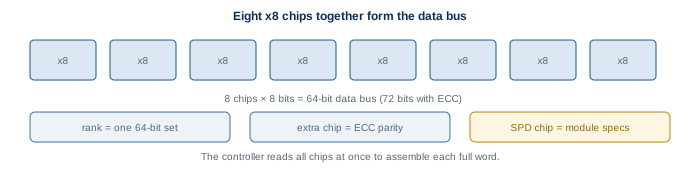
Section titled “15.1 · Ganging 8 chips = a 64-bit word (+ECC, SPD)”That final assembly is the RAM stick. The CPU wants a full 64-bit word per transfer, so eight x8 chips are wired side-by-side, each contributing 8 bits, to form one 64-bit rank (server ECC modules add a ninth chip for 72 bits of error checking). Doubling the chips adds a second rank for more capacity, and a tiny SPD chip stores the module’s specs so the system can configure itself automatically at boot.
15.2 · Edge connector, form factor & the memory channel
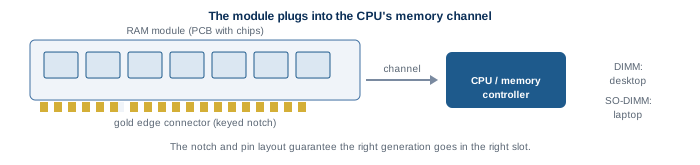
Section titled “15.2 · Edge connector, form factor & the memory channel”The module is a small circuit board (a DIMM) whose gold edge connector carries data, address, command, clock and power into a slot on the motherboard; a notched ‘key’ ensures only the matching generation (DDR4, DDR5…) fits. Desktops use full-size DIMMs, laptops the shorter SO-DIMMs. Once seated, the stick talks to the CPU’s memory controller over a memory channel — and the whole tower of abstraction, from a doped silicon atom up to gigabytes of storage, simply works.