Silicon — the raw element
1.1 · A semiconductor sits between insulator and conductor
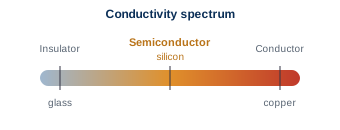
Section titled “1.1 · A semiconductor sits between insulator and conductor”The whole story begins with one element: silicon (Si). It is a semiconductor, meaning its ability to carry electricity sits between a conductor like copper and an insulator like glass. What matters is that this middle position is controllable — we can switch its conduction on and off, and a controllable switch is the foundation of all digital electronics.
1.2 · Group IV: four valence electrons
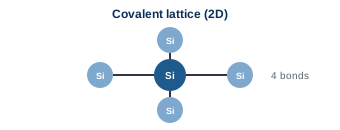
Section titled “1.2 · Group IV: four valence electrons”Silicon sits in Group IV of the periodic table, so each atom has four valence electrons (the outer electrons available for bonding). In a solid, every atom shares these four electrons with four neighbours in covalent bonds, forming a perfectly regular crystal lattice. In a pure, cold crystal every electron is locked into a bond, so almost none are free to move.
1.3 · The band gap — why 1.12 eV is the sweet spot
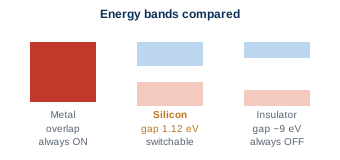
Section titled “1.3 · The band gap — why 1.12 eV is the sweet spot”Quantum mechanics only lets electrons occupy certain energy bands, separated by a forbidden band gap. In silicon that gap is about 1.12 electron-volts — the sweet spot. A metal’s bands overlap (always conducting) and an insulator’s gap is far too wide to cross (never conducting), but silicon’s modest gap can be crossed on demand with a little heat, light, or voltage.
1.4 · Two carriers: electrons (−) and holes (+)
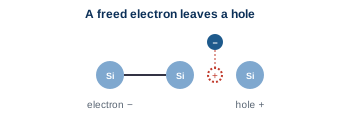
Section titled “1.4 · Two carriers: electrons (−) and holes (+)”When an electron is freed across the gap it leaves behind an empty bond called a hole, which behaves like a mobile positive charge. So silicon carries current in two complementary ways at once: negative electrons drifting one way and positive holes the other. This electron–hole duality is exactly what makes the low-power CMOS logic further on possible.
1.5 · Silicon grows its own insulator (native oxide)
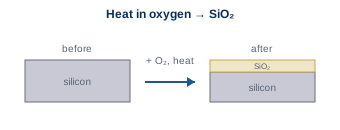
Section titled “1.5 · Silicon grows its own insulator (native oxide)”Silicon has one more gift: heat it in oxygen and it grows its own smooth, stable insulating skin of silicon dioxide (SiO₂). No rival semiconductor forms such a high-quality native oxide, and this self-made insulator will later become the gate insulator inside every transistor — a big part of why the whole industry runs on silicon.